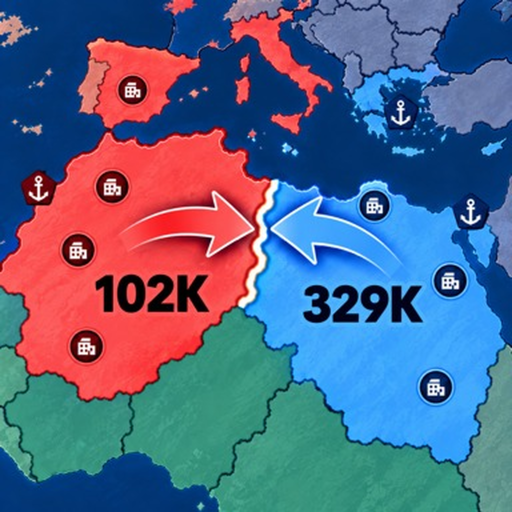
RoWorld Capture Territory: Land Attacks and Troop Boats
Quick answer
- Click nearby empty land to expand your nation.
- For an occupied neighboring target, select it and send troops to attack.
- Use a troop boat for a water-separated destination and account for defending warships.
Take nearby empty land deliberately
RoWorld lets you grow by clicking empty land around your opening position. Use those gains to establish a connected area and a clear next border.
Do not confuse easy early expansion with a reason to empty your army while active opponents are nearby.
After a few gains, look at the position as a whole. The next open patch may expose you to a stronger player, while another direction might leave a simpler boundary to defend.
Attack occupied territory with a chosen commitment
A neighboring nation is an attack decision. Select the target, adjust the percentage you intend to send, and keep track of your remaining troops. Check the enemy army first; territory size does not reliably describe its defending strength.
Capturing part of a nation also changes who borders you. Before extending the push, decide whether the new contact is useful or creates another fight. The combat strategy guide deals with that wider choice.
Cross water as a separate operation
For a country across water, the documented guide uses troop-carrying boats. Choose a coast and destination you can reasonably support. Enemy warships can shoot transports, so a boat leaving your shore is not the same as a completed capture.
Once the troops arrive, reassess the target response and the land you actually hold. Keep the invasion focused on a useful foothold instead of repeatedly sending boats into the same defended route. See amphibious landings for the next planning step.